
The driver whose negligence causes a Thanksgiving travel crash in Texas is generally responsible for the resulting harm. If two or more people contribute to the collision, Texas proportionate responsibility rules can divide fault among them. In covered negligence claims, you generally can recover damages only when your percentage of responsibility does not exceed 50%. Your award is usually reduced by your share of fault.
If you are injured in a holiday collision in Houston, Texas, you may have a claim for medical expenses, lost income, property damage, pain and suffering, and other legally recoverable losses. Liability depends on the evidence, the conduct of everyone involved, and applicable law.









How Is Fault Determined After a Thanksgiving Travel Crash?
Texas generally uses a fault-based approach to vehicle accident claims. To establish ordinary negligence, an injured person generally must show that another party owed a duty of reasonable care, breached that duty, caused the injury, and produced legally compensable damages.
- Duty: A driver generally has an obligation to use reasonable care on the road.
- Breach: Speeding, following too closely, or disregarding a traffic signal may breach that obligation.
- Causation: The careless conduct must have caused the collision and the claimed injuries.
- Damages: The crash must have produced losses recognized by law.
For example, a driver following another vehicle too closely on Interstate 10 may be unable to stop when holiday traffic slows. The investigation would consider speed, spacing, roadway conditions, and other relevant facts before assigning responsibility.
Related Bowen Law Firm reading: https://www.bowenlf.com/how-do-negligence-and-fault-work-in-a-texas-car-wreck/
Which Driving Behaviors Can Cause Thanksgiving Collisions?
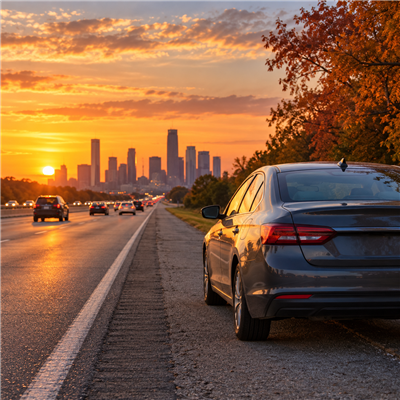
Holiday traffic does not prove negligence by itself. Specific conduct and evidence determine whether a driver failed to use reasonable care.
Distracted Driving
Reading messages, using navigation tools, or adjusting controls may divert attention from traffic. A driver who misses a red light while checking directions may be liable when that distraction causes a collision.
Impaired Driving
Alcohol or drug impairment can affect judgment and reaction time. A driver who causes an injury while impaired may face civil liability. Criminal prosecution and a civil injury claim are separate matters.
Speeding and Unsafe Lane Changes
Speeding, aggressive lane changes, and tailgating can create danger during heavy Thanksgiving traffic. Drivers must account for congestion and the conditions they encounter.
Fatigued Driving
Long drives can reduce attention. Evidence that a driver fell asleep or failed to respond reasonably because of fatigue may support a negligence claim.
Can Multiple Drivers Share Liability in Texas?
Yes. Under Texas Civil Practice and Remedies Code § 33.001, a claimant generally cannot recover damages in an action governed by Chapter 33 when the claimant bears more than 50% of the responsibility. Section 33.012 generally reduces an otherwise recoverable damages award by the claimant’s percentage of responsibility, with additional adjustments possible.
Consider a hypothetical crash with $100,000 in recoverable damages. If the injured driver is assigned 20% responsibility, the award is generally reduced to $80,000 before other applicable adjustments. A 51% share of responsibility would generally bar recovery under § 33.001.
Key point: Being partly responsible does not necessarily eliminate your injury claim. The assigned percentage matters.
Texas proportionate responsibility statute: https://statutes.capitol.texas.gov/GetStatute.aspx?Code=CP&Value=33.001
Who May Be Liable When a Commercial Truck Is Involved?
A collision with a commercial truck can require examining more than the truck driver’s behavior. Depending on the facts and applicable liability rules, responsible parties may include:
- The truck driver, when negligent operation caused the collision.
- The trucking company, when it is legally responsible for the driver’s actions or for its own negligence.
- A maintenance provider, when negligent work contributed to the crash.
- A cargo-loading company, when unsafe loading contributed to the collision.
Driver records, maintenance documentation, onboard data, witness statements, and photographs may help identify the cause. Responsibility must be supported by evidence rather than assumed from the type of vehicle involved.
What Happens When a Rideshare Driver Causes the Collision?
When an Uber or Lyft driver is involved, the available coverage may depend on the driver’s activity at the time of the collision. Relevant questions include whether the driver was logged into the application, waiting for a request, going to pick up a passenger, or carrying a passenger.
A negligent rideshare driver may be responsible for injuries to passengers or other road users. Any company-provided coverage depends on the circumstances and applicable insurance provisions. The presence of a rideshare vehicle does not automatically establish company liability.
What If the At-Fault Driver Is Visiting Texas?
You may still pursue a claim when the responsible driver lives in another state. For a crash occurring in Texas, Texas law will often govern key negligence questions, subject to applicable choice-of-law principles. Out-of-state insurance policies, jurisdiction, and the facts of the collision may affect the process.
Keep the driver’s license information, vehicle registration, insurer details, photographs, and crash report information. An attorney can assess which parties and policies may apply.



What Compensation May Be Available After a Holiday Car Accident?
When another party’s negligence causes your injuries, you may be able to seek damages supported by evidence and applicable law. Potential categories include:
- Medical expenses: Emergency care, hospital treatment, rehabilitation, medication, and qualifying future care.
- Lost income: Earnings lost during recovery.
- Reduced earning capacity: Injury-related limits on your future ability to earn.
- Property damage: Legally recoverable repair, replacement, and related property losses.
- Physical pain and suffering: Compensable physical consequences of an injury.
- Mental anguish: Qualifying emotional harm when supported under Texas law.
The potential value of a claim depends on the injuries, supporting records, liability findings, insurance issues, and other legal circumstances. No single formula determines the value of every Thanksgiving crash claim.
What Should You Do After a Thanksgiving Travel Accident?
Your immediate priorities are safety, medical care, and accurate documentation. When it is safe and appropriate, take these steps:
- Obtain medical care and follow the recommendations of qualified medical professionals.
- Contact law enforcement when required or appropriate, and request the incident or crash report information.
- Photograph vehicle damage, the roadway, traffic controls, and visible injuries when doing so is safe.
- Exchange names, contact details, driver information, and insurance information.
- Record the contact information of witnesses.
- Notify your insurer in accordance with policy requirements and provide accurate facts without guessing about fault.
- Preserve medical records, receipts, repair estimates, photographs, and relevant messages.
Before providing a recorded statement to another party’s insurer, consider seeking legal guidance about your rights and obligations.
Further reading about protecting an injury claim: https://www.bowenlf.com/dont-make-these-7-personal-injury-case-mistakes/
How Long Do You Have to File a Car Accident Lawsuit in Texas?
Texas Civil Practice and Remedies Code § 16.003 generally requires personal injury lawsuits to be filed within two years after the cause of action accrues. For many traffic collisions, that period begins on the date of the crash. Exceptions or other rules may affect a particular case.
The deadline for filing a lawsuit is distinct from an insurance policy’s reporting rules. A claim involving a government entity may also require earlier notice. Texas Civil Practice and Remedies Code § 101.101 generally provides a six-month notice requirement for claims within the Texas Tort Claims Act, subject to statutory qualifications and potentially shorter local requirements.
Prompt review can help identify relevant deadlines and preserve records.
Texas limitations statute: https://tcss.legis.texas.gov/resources/cp/htm/cp.16.htm
Texas Tort Claims Act notice statute: https://tcss.legis.texas.gov/resources/CP/htm/CP.101.htm
Frequently Asked Questions About Thanksgiving Crash Liability
Is the Rear Driver Always at Fault in a Rear-End Crash?
No. A rear-end collision does not automatically prove fault. Following distance, attention, sudden movements, and other facts can affect the determination.
Can You Recover Compensation if You Share Fault?
Possibly. In covered cases, Texas generally permits recovery when your share of responsibility is 50% or less, although your recovery is reduced by that percentage and may be subject to further adjustments.
Does Rain or Bad Weather Excuse Negligent Driving?
No. Drivers generally must use reasonable care in the conditions they face. Weather can be relevant to the assessment of conduct, but it does not automatically excuse negligent driving.
Does a Driver Need a Criminal Charge Before You Can Bring a Civil Claim?
No. Civil liability and criminal prosecution involve different proceedings and standards. A negligence claim may be possible even if no criminal charges are brought.
Speak With a Houston Car Accident Attorney About Your Thanksgiving Crash
After a Thanksgiving crash, you may be dealing with treatment, missed work, and insurer questions while trying to support your family. Bowen Law Firm, PLLC assists people in Houston, Harris County, and nearby Texas communities with personal injury matters. The firm has served Houston-area clients since 2013 and can evaluate the facts of your situation and the legal options that may be available.
Discuss your collision, injuries, and potential next steps with the firm.
Contact Bowen Law Firm: https://www.bowenlf.com/contact/
Learn about the firm’s personal injury practice: https://www.bowenlf.com/houston-personal-injury-lawyers/
This article provides general information and does not constitute legal advice. Reading it does not create an attorney-client relationship.
I had the pleasure of meeting Mr. Bowen and his team. I was extremely impressed! They were all so knowledgeable and personable! I would highly recommend Mr. Bowen. His expertise, professionalism, he's extremely knowledgeable, kind, he has a strong passion for his clients and community. He is also a veteran and very easy to communicate with. I will most certainly be using him for our family lawyer!

Sharon D.
I really appreciate Bowen taking the time to talk with me. Even though he didn’t take my case as I am out of state, he gave me honest guidance without any runaround. He’s straightforward, to the point, and truly genuine in the way he communicates. That kind of honesty is rare to find, and it meant a lot to me. If you’re looking for someone who will be upfront and real with you, Bowen is that kind of attorney!
Raelyn B.
Boe is one of the hardest workers I know. He's caring, compassionate, yet aggressive and tough against the opposition. Boe never quit on me and that meant a lot - he went above and beyond to help me get the best result possible. He was always available to speak to and he always listened to my issues. He communicates well which was important to me. He's a fighter and he cares about his clients
Ray H.