
When a Texas truck accident involves multiple companies, liability may extend beyond the truck driver. A trucking company, freight broker, shipper, cargo loader, maintenance provider, leasing company, trailer owner, or parts manufacturer may share responsibility depending on what caused the crash.
Texas uses proportionate responsibility, which means fault can be divided among several parties. A person generally cannot recover damages if that person is found more than 50 percent responsible. In Houston and across Harris County, these cases often require quick evidence preservation because driver logs, maintenance records, broker communications, cargo documents, and electronic truck data can help show who had control over the trip.
Truck accident claims involving several companies are often won or lost through evidence. The sooner records are preserved, the easier it may be to identify who made the choices that put an unsafe truck, driver, load, or part on the road.








Why Truck Accident Liability Is Often More Complicated Than a Car Crash 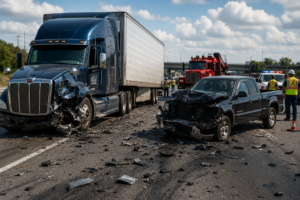
A typical car accident may involve two drivers, two insurance companies, and a police report. A commercial truck accident can involve an entire chain of businesses.
A tractor-trailer moving through Houston may be part of a larger operation involving:
- The driver behind the wheel
- The motor carrier operating under a DOT number
- A company that owns or leases the tractor
- A separate company that owns the trailer
- A shipper that hired transportation services
- A broker that arranged the load
- A warehouse or loading crew that secured cargo
- A maintenance company that inspected or repaired the truck
- A manufacturer that supplied tires, brakes, lights, or other parts
When an 18-wheeler crash happens on I-45, Beltway 8, Highway 249, I-10, or another busy Houston-area route, the first question is not always who hit whom. The deeper question is often what decisions made this crash possible.
If you need guidance after a serious crash, Bowen Law Firm, PLLC handles personal injury matters in Houston and helps injured people understand the claims process. You can learn more about the firm’s injury practice at https://www.bowenlf.com/houston-personal-injury-lawyers/.
The Truck Driver’s Role
The driver may be liable if careless driving caused or contributed to the crash. Common examples include speeding, unsafe lane changes, distraction, following too closely, driving while impaired, ignoring traffic signals, or driving too fast for traffic conditions.
Driver fatigue is also a major issue in truck accident claims. Commercial drivers are subject to federal hours-of-service rules. Driver qualification, safety, and operating requirements are addressed within Federal Motor Carrier Safety Regulations. The FMCSA lists regulations covering driver qualifications, driving of commercial motor vehicles, hours of service, inspection, repair, maintenance, and financial responsibility.
A driver’s conduct matters, but it may not tell the whole story. A fatigued driver may have been pressured by dispatch. A poorly trained driver may have been hired despite a concerning record. A distracted driver may have been responding to company messages. Those facts can move the focus from individual error to company responsibility.



The Motor Carrier’s Responsibility
The motor carrier is often one of the first companies reviewed in a Texas truck accident case. This is the company operating the commercial transportation business. It may employ the driver, control the route, assign the load, maintain safety policies, and manage compliance.
A motor carrier may be liable for:
- Negligent hiring
- Poor driver training
- Unsafe dispatch practices
- Failure to monitor driver logs
- Ignoring prior crashes or violations
- Allowing unsafe trucks on the road
- Failure to inspect or maintain equipment
- Pressure to meet unrealistic delivery schedules
The label placed on the driver does not always end the analysis. A company may call a driver an independent contractor, yet still exercise control over the work. The practical facts matter. Who assigned the trip? Who controlled delivery timing? Who owned the equipment? Who had authority to remove the driver from service?
These details can affect whether the carrier may be held responsible for its own negligence, the driver’s conduct, or both.
Freight Brokers and Shippers
A freight broker may arrange transportation between a shipper and a motor carrier. A shipper may provide the goods being moved. In some cases, these companies may argue that they did not operate the truck and should not be responsible for what happened on the road.
That may be true in some cases, but not always. A broker or shipper may come under review if there is evidence that it:
- Selected an unsafe carrier
- Ignored available safety information
- Set unrealistic delivery demands
- Controlled key parts of the transportation process
- Failed to communicate hazards tied to the cargo
- Required loading or scheduling practices that increased risk
The issue is usually control, knowledge, and foreseeability. If a company simply arranged transportation through a qualified carrier, liability may be harder to prove. If the company knew or should have known that a carrier had safety concerns, or if it controlled the process in a way that created risk, the analysis can change.
I had the pleasure of meeting Mr. Bowen and his team. I was extremely impressed! They were all so knowledgeable and personable! I would highly recommend Mr. Bowen. His expertise, professionalism, he's extremely knowledgeable, kind, he has a strong passion for his clients and community. He is also a veteran and very easy to communicate with. I will most certainly be using him for our family lawyer! Sharon D. I really appreciate Bowen taking the time to talk with me. Even though he didn’t take my case as I am out of state, he gave me honest guidance without any runaround. He’s straightforward, to the point, and truly genuine in the way he communicates. That kind of honesty is rare to find, and it meant a lot to me. If you’re looking for someone who will be upfront and real with you, Bowen is that kind of attorney! Raelyn B. Boe is one of the hardest workers I know. He's caring, compassionate, yet aggressive and tough against the opposition. Boe never quit on me and that meant a lot - he went above and beyond to help me get the best result possible. He was always available to speak to and he always listened to my issues. He communicates well which was important to me. He's a fighter and he cares about his clients Ray H.
Cargo Loaders and Warehouse Companies
Some truck crashes happen because cargo shifts, falls, spills, or makes the trailer unstable. A load that is too heavy, unevenly distributed, poorly secured, or improperly documented can make braking and steering more dangerous.
A cargo-related crash may involve:
- Improperly secured freight
- Overloaded trailers
- Unbalanced weight distribution
- Failure to use proper restraints
- Incorrect cargo documentation
- Hazardous materials handling errors
In a Houston truck accident involving cargo issues, the responsible party may be the driver, carrier, shipper, warehouse contractor, loading crew, or another company involved in preparing the load. Bills of lading, weight tickets, inspection notes, photos, and loading records may become key evidence.
Maintenance Contractors, Repair Shops, and Parts Companies
A truck accident may also trace back to mechanical failure. Brake problems, tire blowouts, steering defects, lighting failures, coupling problems, and underride guard issues can all raise questions about maintenance and product safety.
FMCSA regulations include inspection, repair, and maintenance requirements for commercial motor vehicles, and those records may help show whether the truck should have been on the road.
A maintenance company may be responsible if it performed careless repairs or missed a serious safety problem. A motor carrier may be responsible if it failed to schedule maintenance, ignored driver reports, or kept using unsafe equipment. A manufacturer may be reviewed if a defective part contributed to the crash.
When several companies touched the truck before the crash, each company’s role should be evaluated carefully.
How Texas Proportionate Responsibility Works
Texas law allows fault to be divided among responsible parties in many injury cases. Under Texas Civil Practice and Remedies Code Chapter 33, a claimant may not recover damages if the claimant’s percentage of responsibility is greater than 50 percent.
That rule matters in multi-company truck cases because each party may try to shift blame. The driver may blame the loading crew. The carrier may blame a maintenance shop. The broker may blame the carrier. The defense may also try to blame the injured person.
A case may involve named defendants and potentially responsible third parties. The final allocation of fault can affect how much compensation is available and from whom it may be collected.
This is one reason investigations should begin as soon as possible. Evidence that seems minor at first may become central when several companies begin pointing fingers at one another.
Evidence That Disappears Fast: ELD Data, Dashcam and Driver Logs
Truck accident liability often depends on documents and digital data that are not available at the crash scene. A legal team may work to preserve and review evidence such as:
- Electronic logging device data
- Driver qualification files
- Dispatch records
- Delivery schedules
- Maintenance and inspection records
- Pre-trip and post-trip inspection reports
- Dash camera or cab camera footage
- ECM or black box data
- Broker-carrier agreements
- Bills of lading
- Cargo loading records
- Repair invoices
- Insurance documents
- Phone records and company communications
Photos, witness statements, crash reports, and medical records also matter. In serious injury cases, accident reconstruction experts, trucking safety experts, engineers, and medical professionals may be needed to connect the evidence to the cause of the crash.
The legal process can also overlap with broader litigation issues. Bowen Law Firm, PLLC represents clients in civil disputes and court matters, and information about that practice area is available at https://www.bowenlf.com/litigation/.
Common Scenarios Involving Multiple Companies
Several fact patterns can create shared liability in a Texas truck accident.
- A carrier hires an unsafe driver, then dispatches that driver on a demanding route through Houston traffic.
- A broker selects a carrier with poor safety history to move a load quickly.
- A warehouse crew loads cargo unevenly, and the trailer becomes unstable during a turn.
- A maintenance company performs brake work poorly, and the truck cannot stop in time.
- A trailer owner fails to repair lights or reflective equipment, making the vehicle harder to see at night.
- A manufacturer supplies a defective tire or component that fails during the trip.
Each case turns on evidence. The goal is not to blame every company connected to the shipment. The goal is to identify the companies whose conduct actually contributed to the collision and resulting injuries.
What to Do in the First 48 Hours After a Houston Truck Accident
After a serious truck accident, your health comes first. Get medical care, follow treatment instructions, and document your symptoms. Some injuries become more painful over time, especially neck, back, head, shoulder, and soft tissue injuries.
You should also try to preserve what you can. Keep photos, repair estimates, medical bills, discharge papers, prescription records, and any communication from insurance companies. Avoid giving recorded statements before you understand your rights. Trucking insurers may begin investigating quickly, and their questions may be designed to limit company exposure.
For truck-specific guidance, you can review the firm’s truck accident resource at Houston truck accident lawyers.
How an Attorney Can Help When Several Companies Are Involved
Multi-company truck accident cases require a careful plan. An attorney can send preservation letters, identify insurance coverage, review federal and Texas safety issues, investigate corporate relationships, and determine whether more than one company should be included in a claim.
An attorney can also help calculate damages, which may include medical expenses, future treatment needs, lost income, reduced earning capacity, pain, physical impairment, and other losses recognized under Texas law. In severe cases, long-term care needs and the effect on daily life may be major parts of the claim.
The right approach is thorough and evidence-based. A strong case does not rely on assumptions about trucking companies. It connects specific conduct to specific harm.
How Much Is a Texas Truck Accident Settlement Worth?
There is no fixed settlement amount for a Texas truck accident claim. Value depends on the evidence, how responsibility is divided, the severity and duration of the injuries, medical expenses, lost income, future treatment needs, physical impairment, available insurance coverage and how the crash affects daily life. An early estimate can change as medical treatment continues and additional responsible companies or insurance policies are identified.
A case review with experienced Houston truck accident lawyers can help you understand which records are needed to evaluate both liability and damages. Past results do not guarantee a particular outcome, and every claim depends on its own facts.
Speak With a Houston Truck Accident Attorney
When a truck accident involves multiple companies, you should not have to sort through carrier records, broker agreements, cargo paperwork, and insurance disputes alone. Bowen Law Firm, PLLC helps injured people in Houston, Harris County, and surrounding areas understand their options after serious accidents.
To discuss your situation, contact the firm through https://www.bowenlf.com/contact/ or call 713-255-7321. A conversation with an attorney can help you understand what evidence may matter, which companies may be involved, and what next steps may protect your claim.
This article is for informational purposes only and is not legal advice. Consult an attorney about your specific situation.